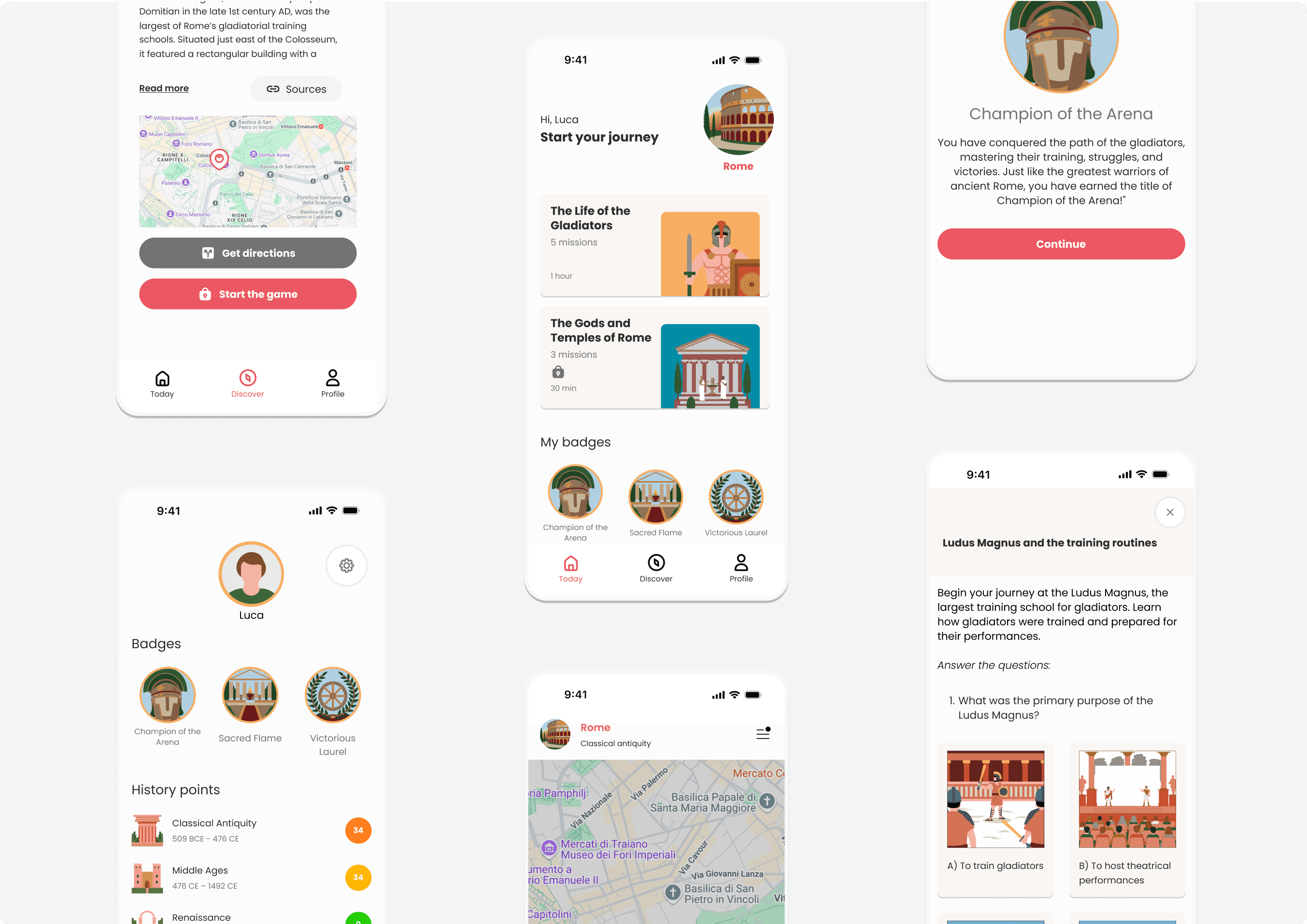
A location-based history game. GPS turns a city into a playable museum: walk to real sites, unlock the stories that happened there, and solve missions to earn your way through history. Designed and built end to end.
- PWA
- Geolocation
- GSAP
- Gamification
01The challenge
The city is the level
Most ways to learn a city's history keep you at arm's length: a plaque you skim, an audio guide you half-listen to, a museum that pulls the story out of the street it belongs to. The context is real but the connection is missing. Sherd puts the story back where it happened. Stories unlock only when you are physically at the historical location, so the ground under your feet becomes the trigger. Rome is the first city, walking past the arena while learning about the gladiators who fought there, rather than reading about them somewhere else entirely.
Research on the ground
The project started in the field, not in Figma. Surveys across three major Italian archaeological sites, Pompei, Ercolano and Villa di Massenzio, uncovered a striking paradox: visitors overwhelmingly want educational content, yet most cannot identify the key monuments they are standing in front of, and they feel lost despite spending hours on site. That gap between interest and understanding is the product brief. Existing tools failed to deliver the contextual, story-driven experience visitors craved, which validated turning passive sightseeing into an active learning adventure.
- 145
- visitors surveyed across three sites
- 90%
- wanted educational content on site
- 26%
- could identify the Basilica at Pompei
- 2019
- featured in print by Sandu Publishing
02The product
Walk.Play. Unlock.
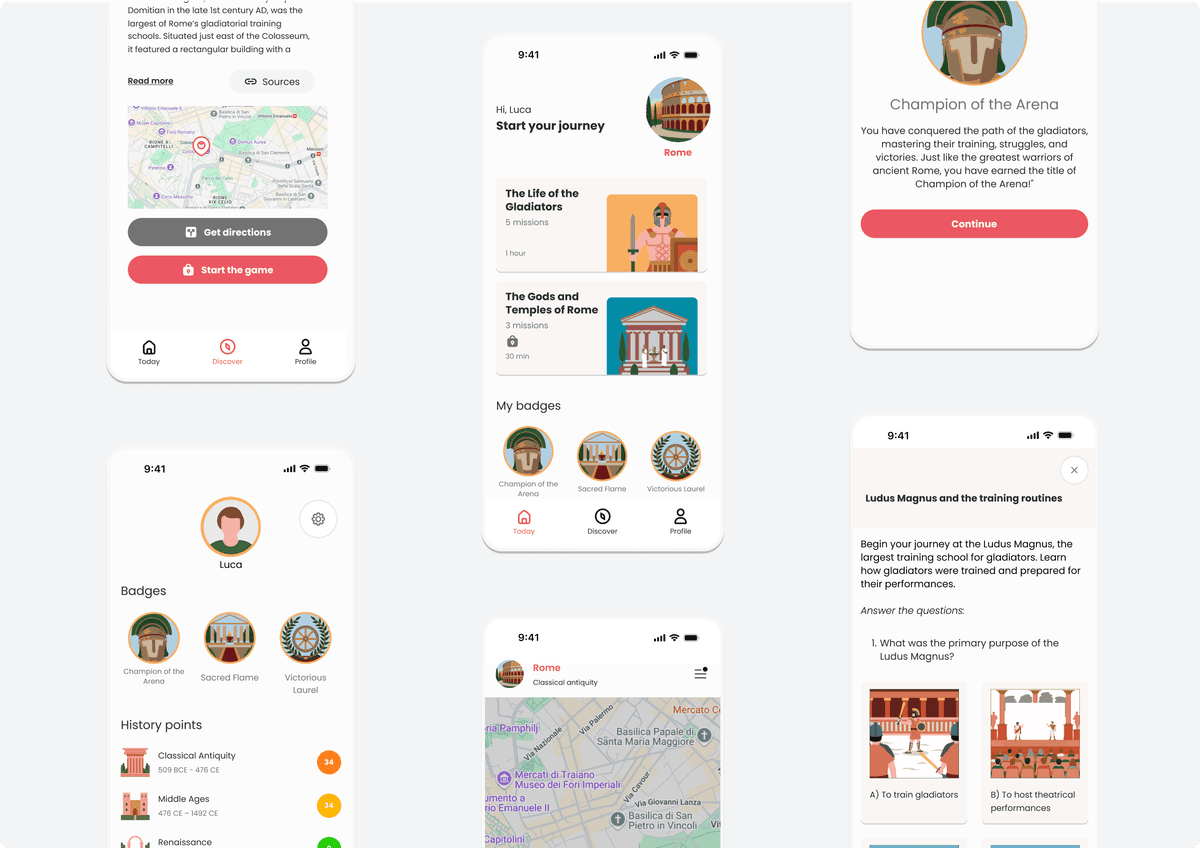
The map is the actual city and the progress bar is your own curiosity. Five moves take a player from opening the app to earning a badge at the real site.
- 01
Open the app
Your location surfaces the historical adventures nearby.
- 02
Choose your path
Curated adventures like The Life of the Gladiators.
- 03
Walk & discover
GPS-guided missions lead you to the real site.
- 04
Play & interact
Minigames and challenges bring the history to life.
- 05
Earn & grow
Badges and artifacts mark you a true explorer.
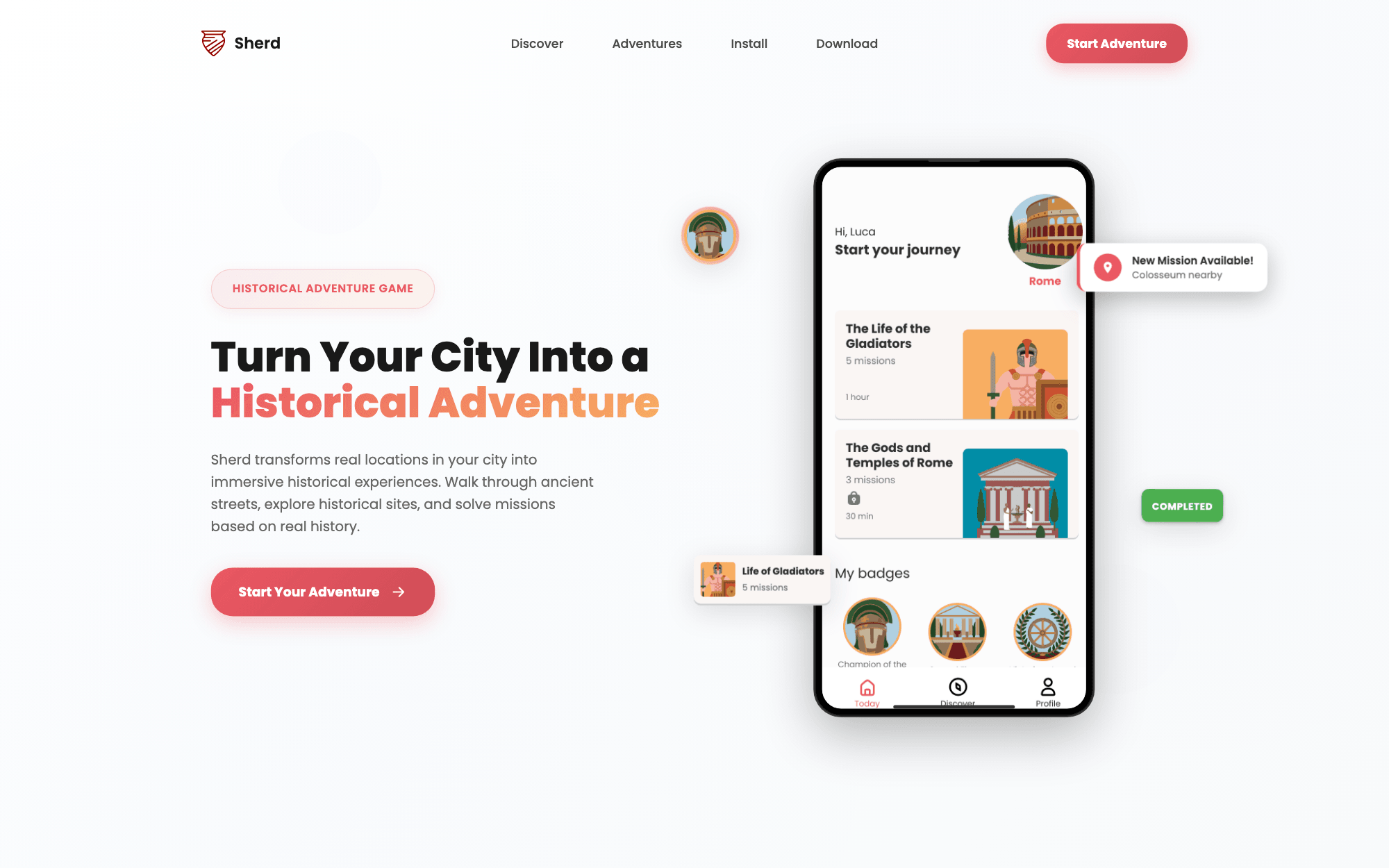
The loop is three moves. GPS guides you to a real site where something happened. On arrival, the place opens into a mission: puzzles, choices and interactions with historical characters, where your decisions shape the story. Finish it and you earn badges, collect artifacts and open the next chapter. It is a game whose map is the actual city and whose progress bar is your own curiosity. The UX had to survive being used outdoors, one-handed, while walking: the UI is built for glanceability, with large targets, high contrast in sunlight and a flow that never asks the player to stop and read a manual. Getting that interaction design right is what keeps the history in front of the player and the interface out of the way.
Walk to the site. Follow GPS directions to the real location where the history took place. Each spot unlocks a new chapter.
Complete the mission. Solve puzzles, make choices and interact with historical characters. Your decisions shape the story.
Unlock achievements. Earn badges, collect artifacts and track your progress as you become a master explorer of your city.
03The gameplay
Learning that plays like a game
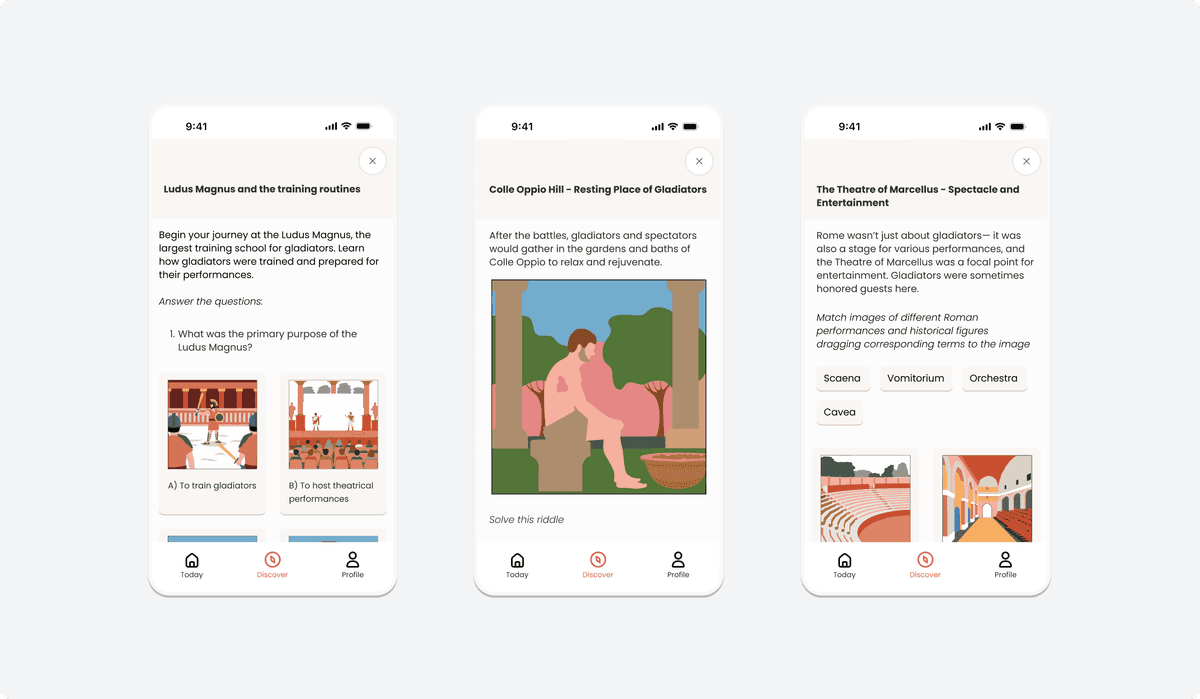
Under the storytelling sits a set of minigames that keep the history active rather than recited: quizzes, image-and-text matches, timeline puzzles, riddles and memory challenges, each tuned to the moment in the story it belongs to. The content is research-based, sourced from Wikipedia and public references, so the play stays honest to the history. Sherd is gamified learning where the reward loop and the education are the same loop.
Ludus Magnus and the training routines
What was the primary purpose of the Ludus Magnus?
- ATo train gladiators
- BTo host theatrical performances
- CTo store Roman weapons
- DTo organise political games
- Gladiators
- Gods & Temples
- Emperors
- The Arena
- Badges
- Artifacts
04Built for the street
The groundis the trigger.
A progressive web app installed straight from the browser, with GPS driving every unlock. No store, no gatekeeper, just a city and a phone.
What the experience promises.
- Stories that unlock only at the real historical location
- Curated adventures like The Life of the Gladiators and The Gods and Temples of Rome
- Interactive missions with characters, choices and consequences
- Badges, artifacts and an achievement trail to track
What the build delivers.
- A progressive web app you install straight from the browser, no store
- GPS location detection driving the whole unlock system
- A scroll-choreographed interface built with GSAP and ScrollTrigger
- Minigames spanning quiz, timeline, riddle and memory formats
05Identity and recognition
Walking through Rome felt like time travel.
The name comes from the archaeological term sherd: the pottery fragments archaeologists use to piece together historical narratives, exactly what the app does with a city's stories. The logo is a stylised pottery shard cut through with dynamic lines, discovery meeting digital, and the coral-red primary colour carries the warmth of terracotta craftsmanship with modern energy. The interface keeps that balance: card-based, illustration-forward and legible in sunlight, with archaeological aesthetics folded into familiar mobile patterns.
Recognition in print
In 2019 Sandu Publishing featured Sherd in 100 Graphic Design Solutions: Interactive Design for Screen, placing the project among pioneering work in digital cultural experiences. The methodology it recognised, archaeological accuracy fused with game mechanics, is the same one driving the current build.
06The visual language
History, with a playful side.
Sherd brings the warmth of pottery into a mobile game. Rounded lettering, coral accents and illustrated adventures connect the archaeological idea behind the name to the next place a player can explore.
Poppins · 400 / 600 / 700
A city full of stories.
Rome · Adventure
The Life of the Gladiators
5 missions · 1 hour
Walk. Play. Discover.
- Chalk#FAF6F4
- Coral#EB5763
- Amber#F8AE62
- Ink#2D2D2D
Make history feel approachable.
Poppins brings round, open shapes to titles and short instructions. A clear weight hierarchy keeps the adventure name, mission count and duration distinct.
Carry the material into the palette.
Coral and warm off-white echo the pottery fragment behind Sherd. Amber and teal distinguish adventure themes, with dark text anchoring the practical information.
Let the story lead, then show the task.
Illustrations introduce each adventure. Compact cards hold the route, duration and missions, while collectible badges give completed stories a place in the player’s collection.
07The outcome
Sherd is in beta and free to play, live in Rome with one historical path open, and Florence, Venice and Pompeii lined up next. Professional narration, ambient sound and AR reconstructions are on the roadmap. Concept, UX and UI, motion and the location engine were designed and built as one practice, showing how code can extend product design from idea to working experience.
Play it at sherdapp.com.